Showing posts with label 100 Volunteer Hours. Show all posts

Tuesday, June 2, 2015

1000 Words: Fellowship

It can be hard to describe to people what the LA Fellows experience is before they've lived it firsthand. Knowing that a picture is worth 1,000 words, here are a few words to try to explain.

A group of professionals, all strangers to each other, come together for nine weeks of training. They come from diverse fields: entertainment, finance, information technology, education, law, customer service, transportation, hospitality, publishing. They come from all over the Los Angeles area, from different ethnicities, ages, education backgrounds. They seem to have little in common except for the circumstance of being unemployed. And yet...

Once the training begins, the Fellows find connections deeper than "what do you do for a living?" They find that they are all giving people who are willing to commit 100 hours to a nonprofit organization. They are committed to a cause, namely finding a job, and willing to do what it takes to complete that important mission. They are curious. They are open to new ideas, to learning how to do their job search better, and live better in the process. They are ultimately resilient. The discovery of their similarities bonds the Fellows. They find that in sharing what they know, diversity of experience is a unique advantage of this program.

The LA Fellows program works hard to nurture a supportive environment where participants can work on finding and removing the things that are getting in the way of finding that next job. Sometimes there are tears, sometimes there are difficult conversations, but there are also tissues, hugs and lots of "AHA moment" insight dispensed. Camaraderie is built and friendships are formed. Networking is about relationships and LA Fellows forge relationships that make them stronger individually and collectively.


Learn more about the LA Fellows program at www.lafellows.org. 

Monday, May 18, 2015

1000 Words: When You Give, You Get

It can be hard to describe to people what the LA Fellows experience is before they've lived it firsthand. Knowing that a picture is worth 1,000 words, here are a few to help you visualize what it's like to be an LA Fellow.

It's not uncommon for people who hear about LA Fellows to think "I need to find a paying job, how can I spend 100 hours of my job search time to volunteer - for free?" The volunteer component of the program actually helps Fellows get back to work faster in several ways:
  • The matching process is structured to give Fellows an opportunity to practice the skills they learn in class someplace other than the high-pressure environment of an interview.
  • It gives structure to the job search, encourages time management and improves focus.
  • Working for a cause they feel passionate about, and making a difference, bolsters confidence.
  • It's a chance to learn new skills and exercise established ones to show employers current relevant experience on a resume.
  • The Fellows project a community-focused image and expand their networks to include active leaders in their communities.
Here are images from just a few of the 300+ LA fellows who've used their time to make a difference in the community while making a difference in their job search.

Center for Nonprofit Management
My Friends Place
Center for Nonprofit Management


Operation Gratitude
Habitat for Humanity
Operation Gratitude


The Soldiers Project
Learn more about the LA Fellows program at www.lafellows.org. 

Monday, April 21, 2014

The Nonprofit Service Piece of LA Fellows

A big component of LA Fellows that sets it apart from other programs that help job seekers transition back into the world of employment is the 100 hours of service each Fellow contributes to a nonprofit organization of their choice. The program includes instruction on the nonprofit sector, optional grant writing classes, and conversation about how to make strategic choices on how and where to donate time in order to complement the goals of the job search.

 Adding volunteer work to the job search helps participants in several ways.

Let's face it: unemployment in 2014 can be a discouraging journey. Hiring managers, mindful of the cost of hiring the wrong person, often take longer to make decisions, taking candidates through rounds of interviews over months before settling on the one they want. Many employers, overwhelmed by the sheer numbers of resumes submitted, don't get back with applicants to let them know when they've received their application or gone with another candidate, even after interviewing. As the days and weeks and months go by it can be easy for a job hunter to start to question why they haven't gotten hired, and slip into depression. It can be hard to keep up morale but getting accepted as a volunteer by a nonprofit can definitely be the encouragement they need.


Upper right photo, L to R: Cohort 9 LA Fellows Victoria Kordysh, May Wang, Wil Walker and Phyllis Baginski contributed their time to Operation Gratitude, which provides much needed care packages to the men and women who serve our country's armed forces.


Meaningful volunteerism, using the skills that are exercised on a professional level every day to make a substantive contribution to the goals of the organization, can be a huge confidence boost, reminding the job seeker why they were so successful in their career in the past and that they still have those skills to contribute.

Working with an organization that the job seeker feels a connection to in some way and being able to further their mission can also be a source of pride and something that they can speak about in interviews with authority and enthusiasm as recent experience.


Terry Scott-Mitchell (center), LA Fellow from Cohort 9, with other volunteers
 working the information table for the Center for Nonprofit Management
Volunteering is great for networking as well. You meet a cross-section of people you might never otherwise come in contact with, and many times have the opportunity to talk and learn about each other as you work. It's not surprising that people who donate their time to nonprofit organizations tend to be involved, generous and caring individuals. These are the kinds of people that prove to be valuable assets to any network.

Finally, nonprofit organizations benefit from the experience
and skills developed by professionals
Terry Scott-Mitchell and Leroy McKinney,
LA Fellows from Cohort 9 who
volunteered at
the Center for Nonprofit Management
who have worked in the for-profit sector. As long as they are open to learning and respectful of the culture, job seekers may find that a career change to the nonprofit sector is a win-win situation, and a volunteer position can showcase their value and the kind of contribution they can make in this industry.

LA Fellows from Cohorts 1-9 have served a wealth of organizations across the Los Angeles area, many well beyond their time in the program. It's an important part of what makes the LA Fellows experience a valuable platform for helping job seekers move forward in their careers.

Monday, April 7, 2014

LA Fellows Graduation Speeches Cohort 9, Part III

Our third and final graduation speaker of the Cohort 9 graduation ceremony was Leroy McKinney, a Customer Service professional. Leroy was asked to speak about the final piece of the LA Fellows journey, the training and how it moves the Fellows forward beyond the program. Here are his words:

Good Morning Everyone,

The Dictionary defines volunteerism as the practice of volunteering one’s time or talents for charitable, educational or other worthwhile activities, especially in one’s community.

One of the unique things about the LA Fellows Program is the partnership between career development and volunteerism.
Each Fellow is encouraged to meet with three nonprofit organizations.  The purpose of this process is to find a match between the nonprofit organization and the Fellow.  Once the match has been made, the nonprofit receives a qualified volunteer and the Fellow has an opportunity to use the skills learned in the LA Fellows Program at the nonprofit.

I gathered Fellows’ comments to describe their volunteer experience.  Allow me to share them with you.

“The interview process made me feel more confident each time. “

I am grateful for the opportunity to do good things. “

“It felt good to know that the nonprofit organization wanted me. “

My volunteer experience is providing me with new skills that I probably would not have acquired.”

“I feel great volunteering for an organization that helps nonprofits and I'm learning a lot at the same time. “
“I volunteer because I get more than I give and done that since I was in the 6th grade when I first came to the U.S.”

 “Volunteering is like riding a bike with training wheels because it gets you comfortable enough to ride off on your own and get back to work.”

The bike metaphor is a great description of the LA Fellows Program. 

(Bike Pantomime)

When I started the LA Fellows Program, I was a little wobbly riding my bike which I called Job Search.  My tool kit for my bike was adequate.

As the program progressed, I learned that my bike was called Career Development.

As I pedaled my bike, I saw a billboard on the left that said “Emotional Intelligence.”  On the right, I saw “Be the Bright Shiny Penny.” A voice went off in the back of my head saying “Don’t be the Debbie Downer.” I put these concepts in my tool kit.

Up ahead on the left was “The Blunt Instrument Won’t Open the Golden Door.”  “What was that about? Oh yeah. When creating your resume focus on specific and concise entries. Vagueness takes you further away from your goal.” On the right was Informational Interviews.”  I put those in my tool kit.

Next, I saw on the left a billboard that said “Networking” and another that said “Volunteer.”  Then I saw “Got Business Cards?” These were placed in my tool kit as well.

I was at the half-way point of my journey and a warning sign beckoned ahead.  The sign said “Change Ahead: S-Curve 5% downgrade.” “What do you mean S-Curve?  I don’t do S-Curves. I’m the straight guy! Why do I have to do an S-Curve?”

As I began my descent into the S-Curve, I heard voices in my head that said “Take deep breaths. Embrace the change.”  I hear these voices as I continued my ride.

About half-way down the S-curve, I noticed that I hadn’t fallen off my bike called Career Development. I thought to myself that I can do this.
Soon afterwards, I noticed there was unexpected road construction.  There were jack hammers and people everywhere.  “Can you believe this?  This wasn’t on the map!” So I began navigating these obstacles on the fly.

Before reaching the bottom of the S-curve, I saw a billboard for “Maximizing Your Social Media Presence.” I added this to my tool kit and continued on.

When I reached the bottom, a sign said “This Part of the Journey Has Ended.”  I moved my bike to the side.

That is where LA Fellows Cohort 9 is today. There will be obstacles in our path in the future.  But we can take solace that we don’t have to face these obstacles alone. When we need support or another opinion to face these obstacles, we can reach out to the other Cohort 9 Fellows through our Facebook Group and phone/e-mail directories.

We will not be afraid because we have Choices. We can choose to go around the obstacles or jump the obstacles.  We no longer have to crash into obstacles which knocks us off our course and kills our momentum. We can ride our bikes with confidence knowing that the LA Fellows Program has better prepared us for the future.

(End Pantomime)

At this time, I would like to thank those people responsible for the program.  Without them, we wouldn’t be here. 

Lennie, Allison, Mary, Keri, Roberto, Dale, Doug, Lynnette, Larry, Jim, Kim, Andrea, Helen, Kristi, Marcie, our local Worksource Centers, nonprofit organizations, advisory board and special guests; let’s give them a round of applause.

Lastly, could I have the LA Fellows Cohort 9 stand? Cohort 9 is gathered here today as those bright, shiny pennies ready for the next challenge! Thank you and God bless!

Thursday, December 5, 2013

"The Experience of a Lifetime"

 
By Kristi Hazama, Cohort 8

Last spring, I had returned from Japan where I taught English for two years.  Feeling motivated and hopeful, I was eager to return to the higher education field and felt excited about the new possibilities.  Immediately, I began submitting resumes and online applications and started researching job opportunities.   Week after week, I remained optimistic, anticipating the phone call that would change my life forever.  However, as time passed, I heard from absolutely no one.  The silence was deafening; the utter lack of response was quite distressing.  And slowly my spirits started to decline.  I wondered if I would ever find a job. 

Around June, a family friend mentioned LA Fellows.  I was hesitant about pursuing this opportunity, thinking I’d receive a job offer soon enough.  But deep down, I was simply afraid.  LA Fellows would be a step out of my comfort zone, teaching me to take a more proactive approach to my job search. 

I decided to attend the final mandatory orientation, albeit still with much reluctance.  But throughout the orientation, I knew there was something different and unique about LA Fellows.  By the end of the morning, I knew this would be the experience of a lifetime.

LA Fellows was indeed, a life changing experience. 

I gained a new level of confidence in my skills and as I rediscovered this confidence, I also gained more clarity into my professional interests and values.  And while this newfound confidence and clarity through LA Fellows was a huge personal win, I am most grateful for the camaraderie among my colleagues in cohort 8. LA Fellows is so unique because it connects people from different educational, professional and life experiences.  I learned a great deal from my cohort, and their support was absolutely incredible.
 
Also, I was helped personally and professionally through the LA Fellows’ volunteer experience.  My hours were completed at the ALS Association, which focuses on the fight to defeat Lou Gehrig’s disease.  It was an incredible experience as we hosted a number of “Walks to Defeat ALS” to raise awareness and funds in the fight to defeat this debilitating disease.  I had the privilege of collaborating with the Walk Directors; we focused on outreach to donors, coordinated with volunteers, oversaw the logistical planning. Volunteering was such a fulfilling experience as you build relationships with people in the organization and make a contribution in a meaningful way. 

I would not be where I am today without LA Fellows.  It truly has been a precious gift, one that keeps on giving.
 
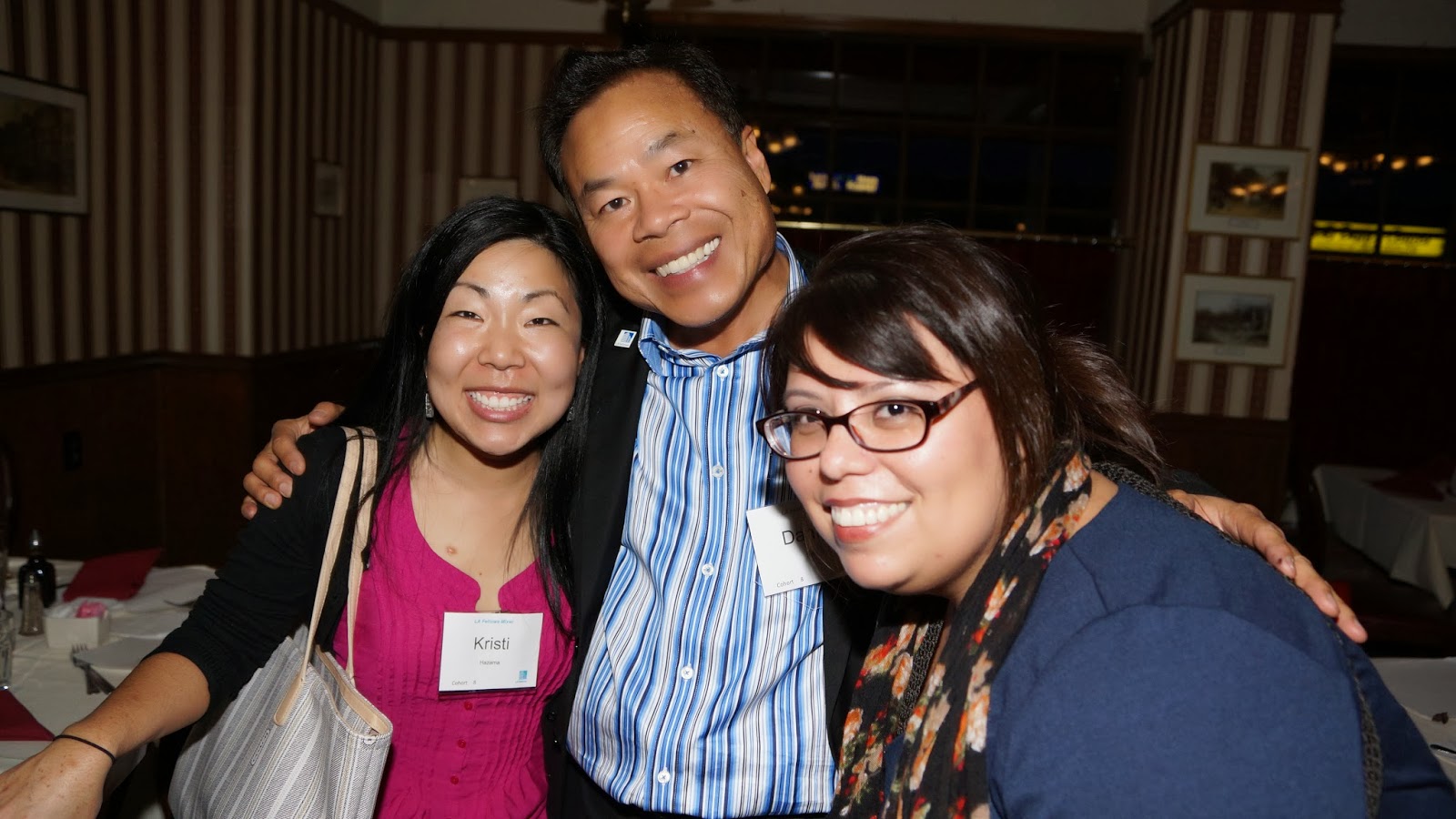
Kristi with Danny Syto and Jennifer Garcia, graduates of Cohort 8

Tuesday, November 12, 2013

LA Fellows is Making National News

Most of our readers are well past their Sesame Street years, but did you know that PBS has created a place for us just around the corner? Their website, Next Avenue, is a place where "grown-ups keep growing." There is a whole section on Work and Purpose with lots of informative articles that job seekers could find useful.

Next Avenue reporter Elizabeth Isele spoke to LA Fellows Program Director Allison Silver and two of our many LA Fellows graduates, Nicholas Koutouras of Cohort 2 and Christine Stenberg of Cohort 1 about our unique, award-winning program. Their stories are heavily featured in an article just posted about getting work after long-term unemployment. Check out the original story here:

http://www.nextavenue.org/article/2013-11/programs-and-tips-help-long-term-unemployed
Next Avenue Logo


or read on...

Programs and Tips to Help the Long-Term Unemployed

How workers over 50 can land a position, even if they've been jobless for months


More than 4 million Americans today make up the nation’s “long-term unemployed,” those who have been out of work for 27 weeks or more. That’s down from 5 million a year ago, but still an enormous number.

About the only good news for these people, often in their 50s or 60s, is that there are some innovative public/private collaborative programs successfully getting the long-term unemployed back to work.

If you’re 50+ and have been
looking for a job for awhile or know someone like that, these programs are worth a look.

Workforce agencies across the country are reaching out to help thousands of displaced boomers, according to
Yvette Chocolaad, employment and training director for the National Association of State Workforce Agencies. Exacerbating the challenge is the increased complexity of job searches today. People looking for work now need social media marketing and personal branding skills as well as an ability to craft their resumes to include the right keywords and meet employers’ needs.

The Platform to Employment Program

One program with proven success is the Connecticut-based
Platform to Employment, profiled by Next Avenue in January and featured on 60 Minutes. Platform to Employment gives jobless people five weeks of training and then places them as interns at local employers — where they generally wind up getting hired.

Lately, Platform to Employment has expanded across the country. This year, the concept has popped up in Dallas, Cincinnati, San Diego, Chicago, Minneapolis, Newark, N.J., and, most recently, Denver. Detroit and Orlando, Fla., are on tap for this winter and San Francisco is expected to follow early next year.

The LA Fellows Program

Chocolaad also gives high marks to the
LA Fellows program. Here's how it works, along with advice for midlife job-seekers from two graduates, Nicholas Koutouras and Christine Stenberg.

Launched in 2010, LA Fellows was created at Los Angeles Valley College, which saw an opportunity to address two pressing community problems: Thousands of highly skilled, middle manager-level men and women looking for work and 30 percent of local nonprofits were in danger of closing because of staffing cutbacks due to the economic climate.

The program was originally funded by Los Angeles’s Community Development Department and is now supported by local WorkSource Centers, plus a variety of government and private partners.

The LA Fellows are selected through an application and interview process just as rigorous as if the candidates were applying for jobs. Project director Allison Silver says she looks for proactive job seekers with a serious commitment and an eagerness to learn.

Once accepted, Fellows receive seven weeks of free training, including sessions on beefing up their computer and
networking skills. Then they’re matched up with nearby nonprofits, where they volunteer their services for 100 hours. The projects range from updating websites to creating marketing plans to event planning to grant writing.

So far, 230 LA Fellows have graduated (each class is called a cohort) and the program has a nearly 70 percent job placement rate in Los Angeles, a city with one of the country's highest unemployment rates: 9.2 percent.

Silver says employers now come to her, asking: "How can I get an LA Fellow to come and work for me?"

Koutouras' Success Story and Advice

Here’s how LA Fellows' graduates Nicholas Koutouras and Christine Stenberg parlayed their training into satisfying, well-paid jobs and the advice they offer to the unemployed:
 LA Fellows graduate Nicholas Koutouras
Koutouras was in his late 40's when he lost his job as senior financial manager at a bank in May 2010. With a master's degree in accounting and information systems, he had built a successful career as a finance exec with large banks, insurers and accounting firms until a corporate merger eliminated his position.

Koutouras knew that hiring managers preferred to offer jobs to people who were currently working and that an LA Fellow volunteering assignment would fill that bill. After being accepted as a Fellow and going through the program's training, he was matched
with the Los Angeles Ronald McDonald House to be a grant writer there.

Just prior to starting that volunteer work, however, Koutouras landed a full-time job as a senior vice president at a major national bank. He took the position (and has since been promoted). But eager to honor his Fellows commitment, Koutouras also joined a finance development committee for the Ronald McDonald House's Board of Trustees.

These days, Koutouras continues volunteering in his community — he’s on the board of the Ronald McDonald House and another group — and is an LA Fellows mentor.

Koutouras’ tips for job hunters:

1. Go get your future. "Be proactive. Once you've decided the direction you wish to go, target a company or industry and focus on preparing for your next role there," he says.

2. Join a professional organization. "Don't tell yourself you can't afford the dues; many waive their fees or reduce them for people who are currently unemployed," says Koutouras. "I joined the Financial Professionals International Association and within months I was made vice president of programs. This allowed me to directly interface with more than 300 senior level executives and practice 'my unemployed story' in a safe environment."

3. Don't waste your time sending out blind resumes or scrolling through web job boards. "Tap the hidden job market revealed to you through your network connections," he says. "Through this effort, you will learn about expansion plans at your target companies, job openings due to promotions and turnover and the identities of influential decision makers. Be sure to follow up on any of their
hidden' job tips."

Stenberg's Success Story and Advice

LA Fellows graduate Christine Stenberg


Christine Stenberg, then in her early 50s, endured a traumatic 30 days from mid-April to mid-May in 2010. Her relationship ended, two of her Labrador retrievers died and she was laid off from her IT management position due to a cutback.

Then, Stenberg was chosen for the first LA Fellows class and she has never looked back.

Her Fellows volunteer match was at a WorkSource career development center, where she trained and helped place unemployed individuals in bio-tech and pharmaceutical companies. After 43 hours of volunteering, WorkSource hired her full-time.

She then helped 60 clients find jobs before the poor economy forced the government to slash funding at the center. Sensing layoffs were coming, Stenberg drew on her new found LA Fellows confidence and skills to land a business analyst job at the National Notary Association.

Stenberg, who has since been promoted to IT manager, shares her story with each new LA Fellows class. Her three tips for the unemployed:

1. Stay positive. "Over time, your situation will change," says Stenberg. "I could have been extremely down when I lost my job and dogs. Instead, the day I was laid off, I arrived home to find four offers on my home that I had put up for sale. As a result, I didn’t have to worry about my finances and could focus on my job search."

2. Research your options online. "See what a company you're interested in says about itself," she advises. "But even more importantly, find out what others are saying about that company. What's its culture? Would you feel comfortable working there? Are current employees happy or do you spot a lot of turnover? If you like what you learn, use your networks to find an employee at the company who’d be willing to give you an
informational interview."

3. Don’t let fear hold you back. "On my first day at LA Fellows," Stenberg says, "I expressed my fear of public speaking, which is a skill that’s key to your success in the program. Throughout the training, I took advantage of every opportunity to speak publicly and, as the program concluded, my colleagues selected me as one of our graduation speakers. Now that I’ve overcome this fear, I have spoken to the Los Angeles Mayor's committee and the Los Angeles Community College Board of Directors, among others, about the importance of the LA Fellows program and what it did for me."


Thursday, October 24, 2013

The LA Fellows Experience by Jonathan Berger

At the informational orientations that are held to introduce people to the LA Fellows program, former Fellows come in and share their experience in the program to give job seekers who are considering applying the inside scoop on what they can expect. Jonathan Berger of Cohort 8 spoke at a recent session and agreed to share his thoughts for the blog as well:

Why did you apply for the LA Fellows program?
 
I am an attorney. I went to UCLA undergrad and then USC Law School.  I even did a semester at Notre Dame.  So I always have someone to root for on a Saturday afternoon.  In my career I’ve worked for several large hospital and healthcare companies, most recently a 12-year stint with a large pharmaceutical company.  Everything was going quite well for me until the division that I was working for was closed down by the parent company.  I was laid off, and went on unemployment for the first time in my life.

 
In many ways I was very lucky.  I was given a generous severance package in light of my length of service, and I was even brought back for a time as a consultant to help with the wind down.  I was provided “outplacement” services including a private coach for interviewing skills and job search strategies, a resume consultant to revise and improve my resume, and similar services.  It was a great “package” – but it didn’t work!

 
I thought that I was doing all the right things, sending out resumes, using the job boards like Indeed, Monster and Simply Hired. I was going to some networking meetings and things like that.   I had some interviews with some good organizations here in Los Angeles, up in the Bay Area, even Arizona.  I came close several times, but nothing clicked.  Over time I settled into a routine of half-heartedly applying for jobs that I didn’t expect to get.  Getting comfortable with being unemployed.  Finding things to occupy my time but not really getting anywhere.

 
Then I heard about the LA Fellows.  I came to an Orientation to find out more about the program.  I didn’t really know what to expect, but I had a feeling that this program was what I needed to get myself back on track.  There’s a famous saying that goes:  “90% of success is showing up”.  I showed up!

What you gained from the training portion of LA Fellows?
 
It may be a cliché that we’re tired of hearing:  “You only get out of something what you put in” – but that sums up the LA Fellows program very well.  Allison Silver and her team have assembled one of the best groups of instructors that I’ve ever seen and put together a series of classes that are more than simply a job search boot camp, they actually provide an education on not only how to be the candidate that will be selected, but how keep that job and continue to build your skills and your network to prepare you for the job after that, and the job after that, and so on. 

What were the benefits of being a part of Cohort 8?
 
There were twenty-two Fellows in Cohort 8.  It wasn’t quite the cast of the movie “The Good, the Bad and the Ugly” but we were a very diverse group.  We did, however, have a few things in common: We’re serious about improving ourselves professionally and we look out for one another!  We are willing to learn, and we are willing to help each other.  Whether it was looking over each other’s resume, conducting practice interviews, staying after class to help with setting up a LinkedIn profile or sharing job leads, the Crazy Eights work as a team.  It was nice to be part of a team again.

 
It was also really good to have a regular schedule.  It may seem strange to say, but having things to do, assignments with due dates, etc., are exactly what we needed to get our minds back in shape.  The instructors know that there’d be nothing worse for us than to land a job and then fall flat on our faces on a task, or have attendance problems with being late.

 
The class schedule is rigorous.  The days are long and the breaks were short.  But that’s what the “real world” is like, isn’t it?  This program will get you in shape – believe me.

Where did you volunteer and what did gain from your nonprofit volunteer experience?
 
I came from the for profit sector.  I didn’t have much experience with nonprofits, at least not with how they operate and what the internal dynamics are like.  As part of the LA Fellows program, and in return for the education and training that LA Fellows receive, they are required to perform 100 hours of service for a nonprofit organization.   The LA Fellows program has a network of nonprofit organizations that are eager to have bright, motivated folks work as interns to gain work experience and make connections.

 
In order to get your internship you have to apply for the jobs the same way you would a “real” job. I got valuable experience applying for the internship positions, tailoring and sending resumes, scheduling interviews, showing up for interviews, being on time, not spilling my coffee, having a spare resume with me and remembering what it says, all that good stuff.

How did being an LA Fellows help you land your job/get more interviews, etc.?
 
The nonprofit internship interviews were a very positive experience.  In particular, it felt nice to be “wanted” and for it to be more of a “two-way street”, where I was actually interviewing the nonprofit and deciding if it was a good fit for me. 

 
My volunteer work was done at The Center for Nonprofit Management in downtown LA.  It is a “capacity builder” helping other nonprofits in Southern California with management and organization strategies, consulting services and executive coaching.  My work there has given me valuable experience in my sector, healthcare, and it has given me something real and current to talk about in interviews, networking conversations, etc.

So, did the LA Fellows work for you?
 
Yes, it worked!  Just recently, I had a three-hour interview with a small law firm downtown.  It  was great to feel so prepared and confident.  I used my STAR stories (where one gives an example of a “Situation, Task, Action and Result” that demonstrates one’s skills and experience) and I presented a strong and well-reasoned case for how the hiring manager would be glad to hire me.  So, I was delighted to be offered a job as an attorney working on healthcare and corporate transactions, which is exactly the kind of work that I wanted to do! The job is starting out as a part-time position, which is actually good so that I can ease into it.  But I get the feeling that it’s going to be full-time fairly soon.

 
I would advise candidates for the LA Fellows program to take the application very seriously, especially the essay or personal statement portion. Even if writing isn’t your strong suit if you’re honest about who you are and what you want to do then that will come through.  Allison and the LA Fellows team spend many hours on the selection process, and there really are many qualified people who don’t get in – so don’t be discouraged if you don’t get chosen the first time, you can apply again.

I can honestly say that I don’t think that I’d have gotten my new job without the training and support that I received from the LA Fellows program.  If you want to really take your job search to the next level then this is the program for you.

Monday, October 21, 2013

The Difference Volunteering Makes


In addition to 140 hours of classroom training on job search techniques and executive level professional topics, an important part of the LA Fellows program involves each Fellow volunteering at least 100 hours of their time and talents for a project at a nonprofit organization of their choice. The volunteer component is the piece that sets LA Fellows apart from other programs designed to retrain and get unemployed individuals back to work.

The most recent class (or “Cohort” in Fellow-speak) graduated August 30th and has shown amazing cohesiveness and commitment to staying in touch, supporting each other and making sure they all stay on the path of what they learned in the program until they are re-employed. The “Crazy 8’s,” as LA Fellows Cohort 8 has dubbed themselves, recently gathered for their weekly accountability meeting to check in on their progress, cheer for those who’ve landed jobs so far and chart their plans for the next week. Most of them have now completed their 100 hour commitment to their nonprofits and they reflected on their experiences.

Bruce Elsperger, an experienced live-entertainment management professional, chose to donate his hours to EngAGE, an organization that brings the arts to local senior centers. Bruce spent his hours teaching drama and improv classes for three of their centers around the Los Angeles area. When he started LA Fellows training, he was thinking of finding a career that would allow him to work with baby-boomers making the transition to the next phase of life. According to Bruce, his volunteer internship reaffirmed that passion and made him more sure of the path he wants to pursue.

At one center he taught at, he had a dramatic performance for their last class. On the day of the performance, one of the seniors was taken to the hospital (over protestations that he couldn’t miss the show!) and Bruce had to fill in. That meant someone had to take over the duties of the narrator that Bruce, as the director, would otherwise have done. He asked one of the ladies who came to the group but had not previously participated if she would take over for him. She was honored that he believed she could do it and told him after the show, “You have just fulfilled one of the items on my bucket list.” 

At another site, a small group gathered on their last day to do prepared readings. One woman arrived for the class who had not previously been available to attend. Bruce let her know it was the last day, but asked if she would be willing to do a cold reading with one of the other residents. She agreed, with the disclaimer that she had never done anything like that before. As showbiz folks would say, she killed, she performed like an expert actress. As she returned to her seat showered by applause, she told him “You have fulfilled a 5 year old’s dream.”

As each of the three classes was ending, evaluation forms were passed out to the participants to solicit feedback on the experience. There were many rave reviews, praising his efforts, but Bruce told the other Fellows at the meeting about one particular evaluation that really touched him. After the participant wrote that the best thing about the class was the teacher, the form asked what he/she had learned. The answer was: “to try to live again.”

As Bruce’s experience shows, LA Fellows volunteer component gives participants an opportunity to try new things, keep their existing skills current and test their ideas for transitioning. It also reminds Fellows that they are not defined by their unemployment, they are still professionals, valuable experts who have a lot to contribute.  The organizations Fellows serve, and their clients, benefit in so many meaningful ways.

Of course the most important thing is that LA Fellows helps people get back to work. In addition to all the good he did for others, Bruce got a paying job offer to teach a series of classes for one of the senior centers he worked at. Bravo Bruce! Another LA Fellows success story, in more ways than one.

Tuesday, May 21, 2013

LA Fellows has been the most powerful tool in my job search

LA Fellows has been the most powerful tool in my job search. The support and connections are limitless. I am a professional fundraiser, so I chose The Southern California Center for Non Profit Management as my 100 hour internship. My official title for the volunteer position was Logistics and Seminar Recruiter.


In this role, I coordinated seminars, participated in grant writing, leadership, social media, marketing, and fund development meetings, and I met the founders and the fundraisers from more nonprofits then I ever knew existed.


This all culminated on Friday May 10th with the 501 Conference. Speakers at this huge event included the president and CEO of United Way, the President of Southern California Grantmakers, the Executive Director of First 5, Los Angeles and the author of "Who Stole the American Dream.”


I am so inspired by everyone I have met. And yes, these are the people who will change poverty, education and entire communities in LA. Yes we will!!


Debra Goldfield

LA Fellow Cohort 7